Last updated: February 28, 2026
Key Takeaways
- AI anxiety stems from real workplace changes: Over half of US workers fear AI displacement, fueled by automation rollouts and unclear communication from leadership
- Upskilling reduces uncertainty: Learning AI literacy and focusing on human judgment skills (critical thinking, creativity, collaboration) builds confidence and job security
- Breathwork offers immediate relief: Simple techniques like box breathing (4-4-4-4 pattern) can calm stress responses during work hours without leaving your desk
- Boundaries prevent AI-driven burnout: Workers using AI tools often face expanded workloads; intentional pauses and protected focus time are essential
- Leadership communication matters most: Fewer than 20% of employees hear from managers about AI impacts; transparent conversations build psychological safety
- Human skills remain your edge: “Good taste,” judgment, and relationship-building are capabilities AI can’t replicate in 2026
- Productivity theater signals deeper fear: Sending early-morning emails to prove busyness reveals anxiety about job security, not actual performance
Quick Answer
AI anxiety in the workplace in 2026 is widespread because automation is reshaping roles faster than organizations can communicate plans or provide training. The most effective strategies combine skill-building (AI literacy, critical thinking), immediate stress relief (breathwork, mindfulness breaks), and organizational support (clear career pathways, manager transparency). Workers who upskill while setting boundaries around AI-expanded workloads report lower anxiety and sustained productivity.
What Is AI Anxiety and Why Is It Spiking in 2026?
AI anxiety is the stress and fear workers experience when automation threatens job security, changes daily responsibilities, or creates uncertainty about career futures. In 2026, this anxiety has intensified because AI tools are moving from experimental to standard across industries, while many employers haven’t clarified how roles will evolve.
Recent data shows 52% of US workers fear AI displacement, up from previous years. This spike isn’t irrational, Colorado’s AI Act (effective February 2026) and the EU AI Act (fully applicable August 2026) now regulate high-risk AI in hiring and promotions, proving that automation in employment decisions is real and accelerating.
Common triggers include:
- Watching AI handle tasks you used to own
- Unclear messages from leadership about future roles
- Seeing colleagues laid off after automation rollouts
- Pressure to adopt AI tools without adequate training
- Expanded workloads because AI “should” make you faster
Choose upskilling if you’re in a role with repetitive tasks that AI can automate. Choose boundary-setting if you’re already using AI but feeling burned out from doing more work in the same hours.
One major mistake: assuming silence from managers means your job is safe. In fact, fewer than 20% of employees have heard from leadership about AI impacts, creating a “leadership vacuum” that fuels rumors and stress that can reduce your focus and even appetite.
How Does AI-Driven Change Fuel Workplace Burnout?
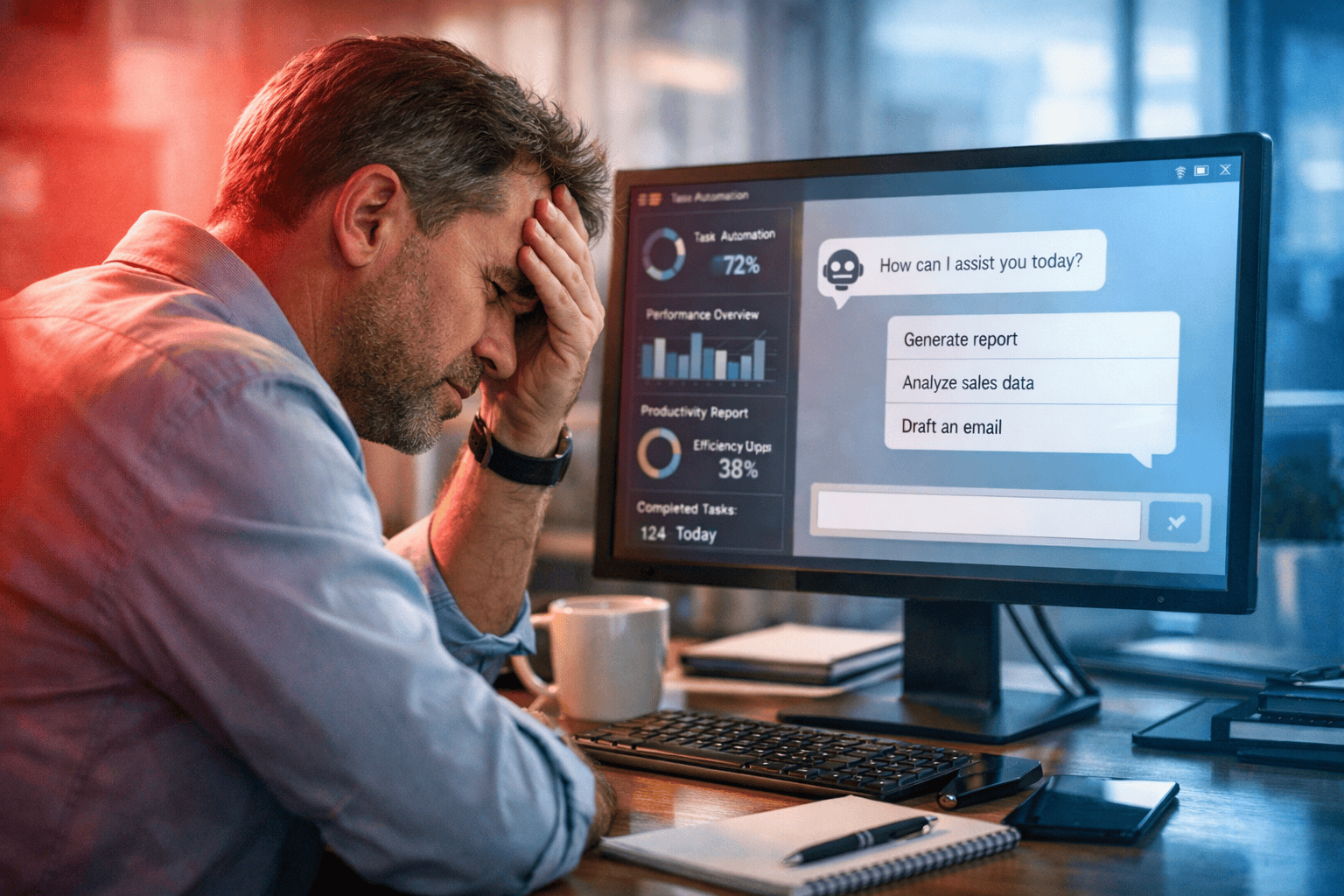
AI doesn’t just replace tasks—it often expands expectations. Research from UC Berkeley in February 2026 found that workers who adopted AI tools experienced productivity gains but also burnout because employers assigned them more work to fill the “saved” time.
This creates a paradox: you’re more efficient but more exhausted. The pressure to prove you’re still valuable leads to “productivity theater,” where employees send early-morning emails or stay visibly busy to signal they’re not replaceable.
Signs of AI-driven burnout:
- Working longer hours despite using “time-saving” tools
- Constant context-switching between AI outputs and human judgment
- Guilt about taking breaks because AI “never stops”
- Anxiety about being compared to AI performance benchmarks
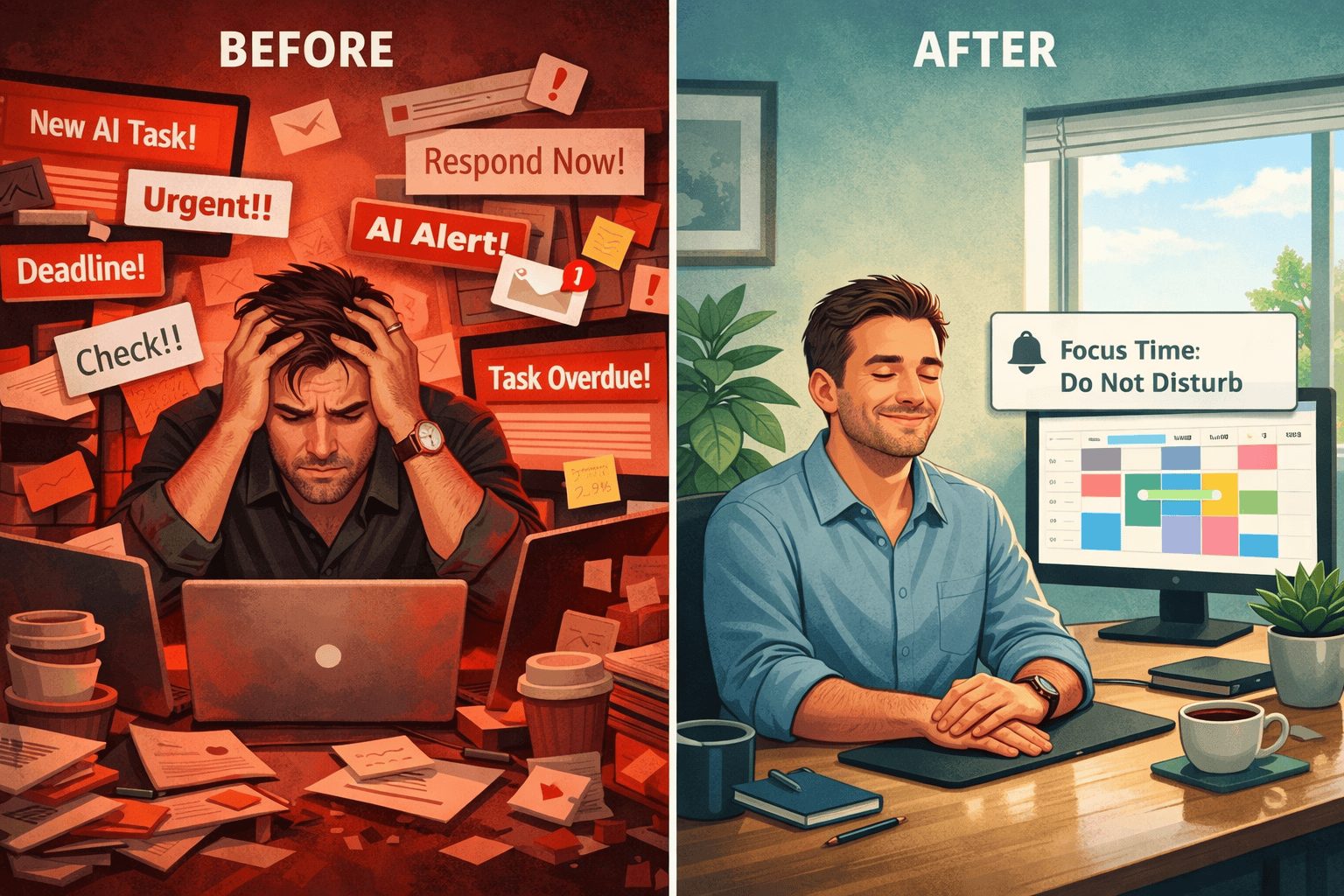
Practical fix: Build intentional pauses into your day. Block 15-minute windows on your calendar labeled “focus time” or “review,” and use them to step away from screens. This isn’t optional—it’s a boundary that prevents the treadmill effect of AI-augmented work.
For deeper relief, consider techniques to release emotional stress that builds up from constant change.
What Skills Should You Build to Reduce AI Anxiety in the Workplace in 2026?
The best defense against AI anxiety is capability. When you know what AI can’t do, you stop competing with it and start collaborating with it.
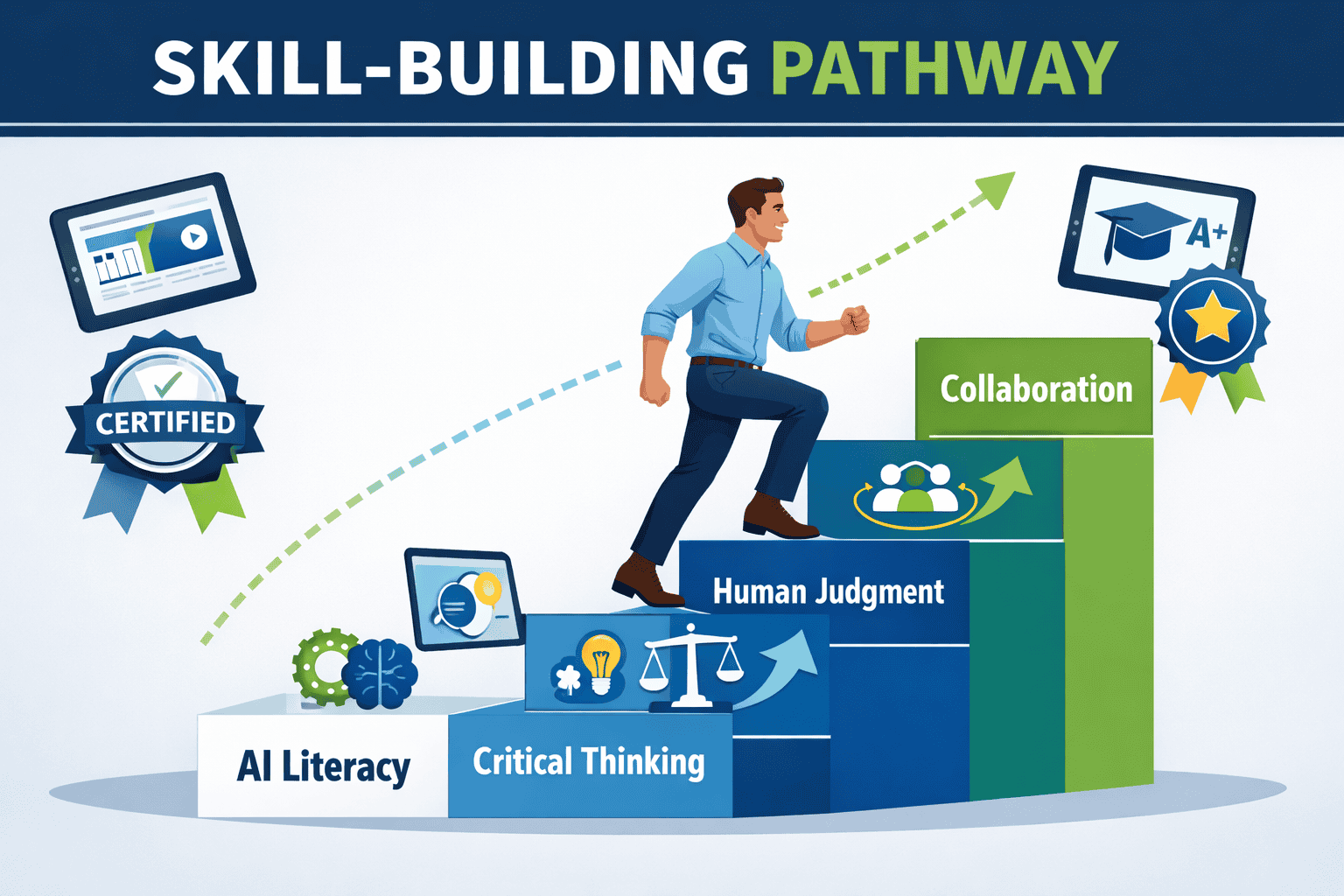
The US Department of Labor released an AI literacy framework in February 2026 to guide nationwide upskilling. Focus on these areas:
Core Skills That Outlast Automation
- Critical thinking and judgment: AI generates options; humans decide which fit context, ethics, and strategy
- Creativity and problem-solving: Novel solutions require understanding nuance AI models miss
- Relationship-building: Trust, empathy, and collaboration remain human domains
- AI literacy basics: Understanding how models work, their limits, and when outputs need verification
Choose AI literacy training if you’re unsure how tools in your field operate. Choose advanced human skills (creativity, judgment) if you already use AI daily but want to differentiate yourself.
OpenAI CEO Sam Altman emphasized in February 2026 that “good taste” and human judgment are the key edges jobseekers have during the “AI jobpocalypse.” This means developing the ability to evaluate AI outputs critically, not just accept them.
Common mistake: Learning AI tools without learning when not to use them. Knowing limits builds confidence and prevents over-reliance.
For a mindset shift, explore how stress can actually help you achieve goals when channeled into skill-building.
How Can Breathwork and Mindfulness Reduce Stress During Work Hours?

When anxiety spikes mid-workday, you need immediate relief that doesn’t require leaving your desk. Breathwork is the fastest, most accessible tool.
Box Breathing (4-4-4-4 Technique)
This pattern calms your nervous system in under two minutes:
- Inhale through your nose for 4 counts
- Hold your breath for 4 counts
- Exhale through your mouth for 4 counts
- Hold empty lungs for 4 counts
- Repeat 4-6 cycles
Why it works: Box breathing activates your parasympathetic nervous system, which counteracts the fight-or-flight response triggered by job uncertainty.
Micro-Mindfulness Sessions
Between meetings or tasks, try a 60-second reset:
- Close your eyes and notice three sounds around you
- Feel your feet on the floor and hands on your desk
- Name one thing you can control right now (your next action, your breath, your posture)
Choose breathwork if you need instant calm during high-stress moments. Choose micro-mindfulness if you’re feeling scattered and need to regain focus.
These techniques pair well with stress-busting benefits of humor—a quick laugh with a colleague can reset your mood just as effectively.
What Boundaries Prevent AI-Expanded Workloads From Burning You Out?
Setting boundaries isn’t about resisting AI—it’s about protecting your capacity so you can sustain productivity long-term.
Boundaries That Work in 2026
| Boundary Type | Example | Why It Matters |
|---|---|---|
| Time blocks | “No AI tool reviews after 4 PM” | Prevents endless refinement cycles |
| Task limits | “I’ll use AI for drafts, not final decisions” | Maintains human oversight and judgment |
| Communication norms | “I respond to messages within business hours only” | Stops “always-on” expectations |
| Focus time | “Two 90-minute deep work blocks daily, no AI alerts” | Preserves creative and strategic thinking |
Practical step: At the start of each week, identify one task you’ll delegate to AI and one task you’ll protect as human-only. This balance prevents both under-use (falling behind) and over-reliance (losing skill).
Edge case: If your employer measures productivity by AI-assisted output volume, document the quality improvements you make through human review. Shift the conversation from “how much” to “how well.”
Sometimes, the real challenge is when your brain plays tricks on you by catastrophizing job loss scenarios. Boundaries create structure that quiets those spirals.
How Should Organizations Support Employees Facing AI Anxiety?
Individual strategies help, but organizational support is the foundation. Companies that reduce AI anxiety see better adoption, lower turnover, and sustained productivity.
What Effective Leaders Do
Transparent communication: Managers should explain which roles will change, how AI will be used, and what new skills the company will support. Silence breeds rumors.
Psychological safety: Create spaces where employees can voice fears without judgment. Regular check-ins about AI impacts build trust.
Career pathways: Show clear routes for growth that incorporate AI skills. If someone’s current role shrinks, what’s the next step?
Training investment: Provide AI literacy programs, not just tool tutorials. Help people understand why and when to use automation.
Choose this approach if you’re a manager or leader responsible for team morale during transitions.
Common mistake: Rolling out AI tools without explaining the strategy behind them. Employees assume the worst when left to interpret changes alone.
For teams navigating uncertainty, it helps to let the pressure of stress fuel growth rather than paralyze progress.
What Are the Biggest Mistakes People Make When Dealing With AI Anxiety?
Avoiding these pitfalls can save months of unnecessary stress:
Mistake 1: Ignoring AI entirely. Hoping automation will pass you by guarantees you’ll fall behind. Engage with tools at your own pace, but engage.
Mistake 2: Over-relying on AI without building judgment. If you accept every AI output without review, you lose the critical thinking edge that makes you irreplaceable.
Mistake 3: Comparing yourself to AI. You’re not competing with a model—you’re collaborating with it. Focus on what you bring that it can’t.
Mistake 4: Waiting for your employer to fix your anxiety. While organizational support matters, your upskilling and boundary-setting are within your control today.
Mistake 5: Productivity theater instead of real skill-building. Sending early emails to look busy wastes energy better spent on learning or strategic work.
Quick decision rule: If an action reduces anxiety and builds capability (like taking a course or setting a boundary), do it. If it only masks fear (like performative busyness), skip it.
When anxiety leads to worst-case thinking, remember not to let your mind expect the worst outcomes—focus on what you can control.
Conclusion
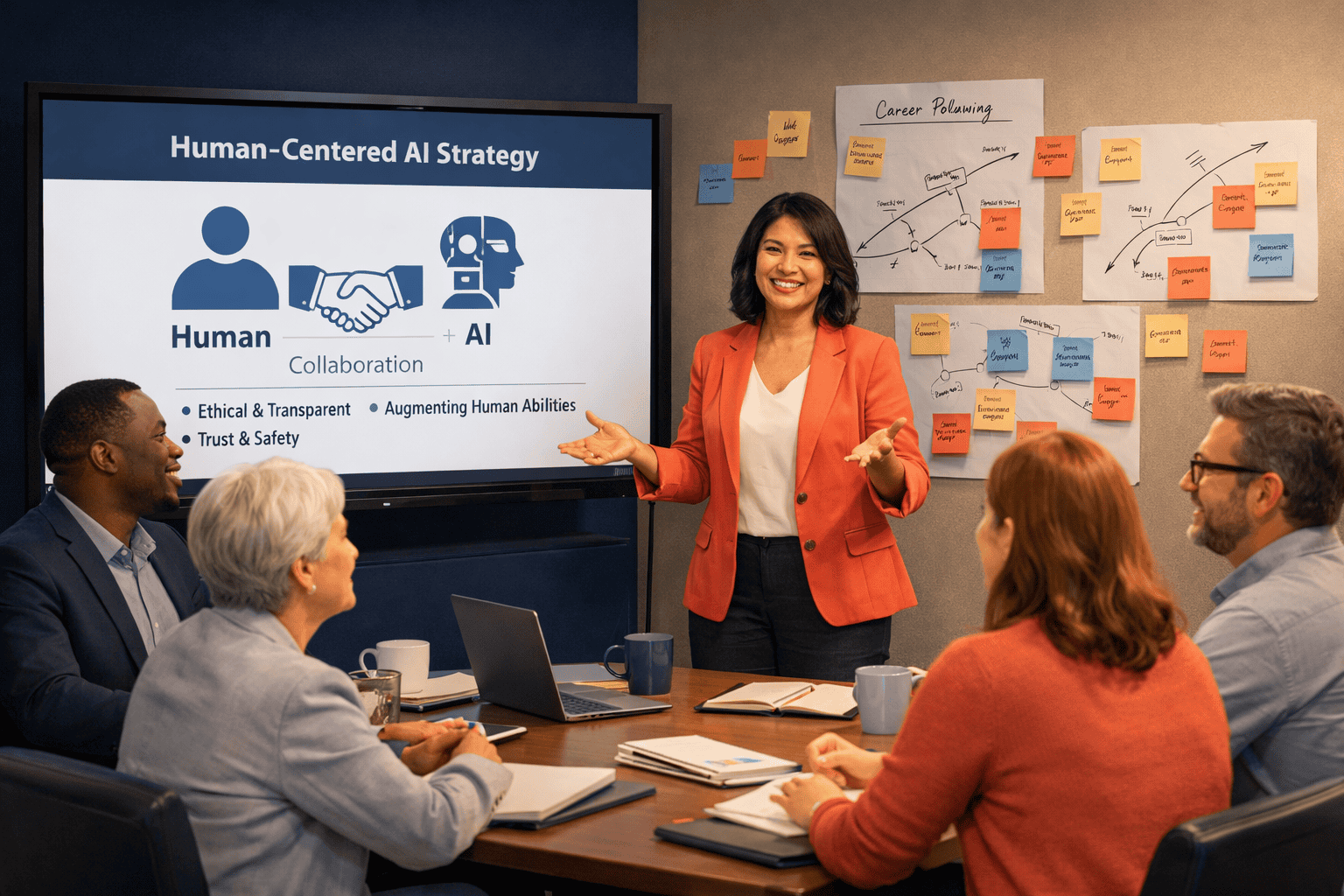
AI anxiety in the workplace in 2026 is real, widespread, and driven by rapid automation paired with unclear communication from leadership. But it’s also manageable when you combine skill-building (AI literacy, critical thinking, human judgment), immediate stress relief (breathwork, mindfulness breaks), and smart boundaries (protected focus time, task limits).
Start with one action this week: learn one AI tool relevant to your role, practice box breathing during a stressful moment, or block two hours of focus time on your calendar. These small steps build the capability and calm you need to navigate workplace changes without burning out.
The future of work isn’t humans or AI—it’s humans with AI, guided by the judgment, creativity, and relationships only you can provide. Build those edges, protect your energy, and you’ll not only reduce anxiety but boost the productivity that matters: meaningful, sustainable work.
FAQ
What is AI anxiety in the workplace?
AI anxiety is the stress and fear employees feel when automation threatens job security, changes their roles, or creates uncertainty about career futures. It’s fueled by rapid AI adoption and lack of clear communication from employers.
How common is AI-related job fear in 2026?
Over 52% of US workers report fearing AI displacement, according to recent workplace surveys. This anxiety has increased as AI tools move from experimental to standard across industries.
What skills help reduce AI anxiety?
Focus on AI literacy (understanding how tools work and their limits), critical thinking, creativity, human judgment, and relationship-building. These are areas where humans outperform AI and remain valuable.
Can breathwork really help with workplace stress?
Yes. Techniques like box breathing (4-4-4-4 pattern) activate your parasympathetic nervous system, calming the fight-or-flight response in under two minutes. It’s effective for immediate relief during high-stress moments.
How do I set boundaries when AI expands my workload?
Block focus time on your calendar, define which tasks you’ll use AI for versus handle manually, and communicate response-time expectations. Protect capacity to prevent burnout from AI-augmented productivity demands.
Should I learn AI tools even if I’m anxious about them?
Yes, but at your own pace. Engaging with AI tools builds competence and reduces fear of the unknown. Start with one relevant tool and focus on understanding when to use it and when not to.
What should managers do to reduce team AI anxiety?
Communicate transparently about which roles will change and how, create psychological safety for voicing concerns, provide AI literacy training, and show clear career pathways that incorporate new skills.
Is productivity theater a sign of AI anxiety?
Yes. Sending early-morning emails or staying visibly busy to prove you’re not replaceable signals deeper fear about job security. It’s better to invest that energy in actual skill-building.
What’s the biggest mistake people make with AI anxiety?
Avoiding AI entirely or waiting for employers to solve the problem. Your upskilling and boundary-setting are within your control today and have the most immediate impact on reducing stress.
How long does it take to feel less anxious about AI at work?
It varies, but most people report reduced anxiety within 2-4 weeks of starting skill-building or implementing stress-relief practices. Consistency matters more than speed.
Can AI anxiety lead to burnout?
Yes. Workers using AI tools often face expanded workloads because employers expect higher output. Without boundaries and intentional pauses, this leads to exhaustion despite productivity gains.
What if my employer isn’t providing AI training?
Seek free or low-cost resources like the US Department of Labor’s AI literacy framework, online courses, or industry webinars. Self-directed learning builds capability even without organizational support.