
Last updated: February 28, 2026
Key Takeaways
- Evidence-based 10-15 minute unwinding rituals like gratitude journaling and media breaks can reset work stress and improve sleep quality without requiring major lifestyle overhauls
- Insomnia is a biological timing problem, not just a behavioral issue—strengthening circadian rhythms through timed light exposure and structured routines addresses the root cause
- Cognitive behavioral therapy for insomnia (CBT-I) outperforms sleeping pills long-term, with 70-80% of patients experiencing sustained improvements
- Doomscrolling before bed undermines sleep quality by keeping your brain in high-alert mode when it should be downshifting
- Workplace stress costs the global economy over $1 trillion annually in lost productivity, making mental health reset routines a strategic priority, not a luxury
- Micro-habits beat willpower—short, discreet techniques like breathing resets fit naturally into work moments and build momentum gradually
- Timing matters more than duration—a consistent 15-minute evening ritual at the same time daily strengthens your body’s natural sleep-wake cycle
- Physical cues create mental shifts—simple actions like putting your phone in airplane mode signal your brain that work time is over
Quick Answer
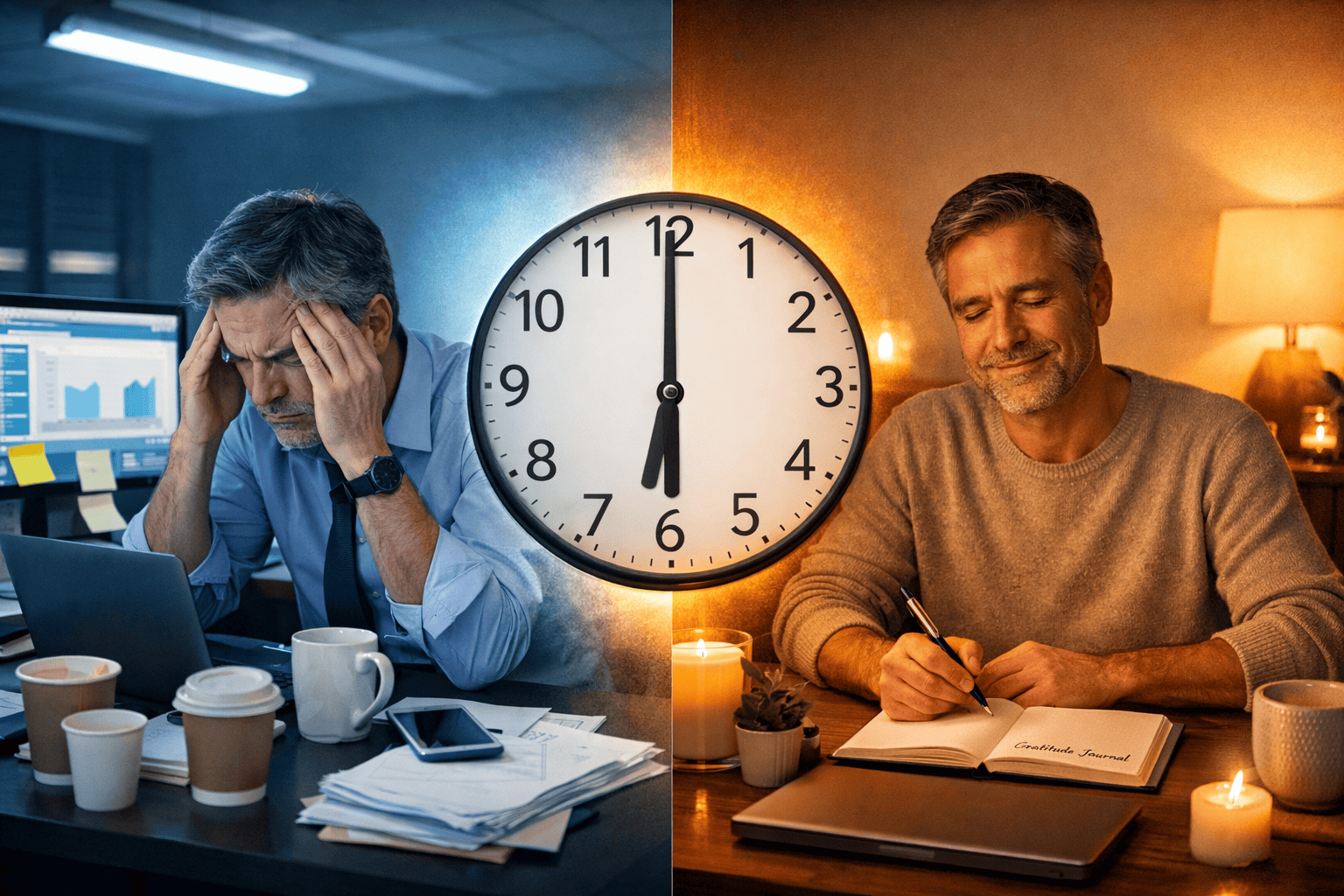
Mental health reset routines are structured 10-15 minute daily practices that help you transition from work stress to restful sleep by addressing both behavioral patterns and biological timing. Recent research from the University of South Australia shows that insomnia involves cognitive peaks delayed by about 6.5 hours compared to healthy sleepers, meaning your brain fails to properly downshift at night. Simple evening rituals—gratitude journaling, media breaks, gentle stretching, and timed light management—strengthen your circadian rhythm and prevent the stress-insomnia-depression cycle that affects millions of working professionals in 2026.
Why Do Mental Health Reset Routines Matter for Work Stress and Insomnia?
Mental health reset routines create a deliberate boundary between work demands and personal recovery time, which your brain desperately needs but rarely gets in 2026’s always-connected work culture. When you skip this transition, your prefrontal cortex stays in high-alert mode, processing work problems and scanning for threats even when you’re physically away from your desk.
This matters because work stress and insomnia feed each other in a vicious cycle. Stress keeps you awake, poor sleep reduces your stress tolerance, and the combination increases your risk of depression and burnout. Depression and anxiety already cost the global economy over $1 trillion annually in lost productivity, making this a business problem as much as a personal health issue.
The biological reality: Your brain needs clear signals that work time is over. Without intentional reset practices, you’re asking your nervous system to shift gears on its own—and it usually can’t.
Choose a reset routine if you:
- Find yourself replaying work conversations at 11 PM
- Reach for your phone “just to check” before bed
- Feel tired but wired when you finally lie down
- Wake up still thinking about yesterday’s problems
Common mistake: Treating relaxation as something that happens automatically once you leave work. Your brain needs structured cues to transition from productivity mode to recovery mode.
What Makes an Effective Mental Health Reset Routine?

An effective reset routine combines three elements: consistent timing, minimal screen exposure, and activities that engage your body rather than your analytical mind. The routine should last 10-15 minutes, happen at the same time each evening, and include at least one practice that creates a physical state change.
Core components that work:
- Gratitude journaling (3-5 minutes): Write three specific things that went well today, focusing on details rather than generic statements
- Media break (complete): Put your phone in airplane mode and place it in another room—not on your nightstand
- Gentle movement (5 minutes): Light stretching, progressive muscle relaxation, or slow breathing exercises
- Sensory shift (2-3 minutes): Dim lights, change into sleep clothes, or drink herbal tea to signal transition time
Decision rule: Choose activities you’ll actually do consistently over theoretically optimal practices you’ll skip. A simple routine you follow beats a perfect routine you avoid.
Edge case: If you work night shifts or irregular hours, anchor your reset routine to a consistent time before your designated sleep period rather than a specific clock time. Your circadian rhythm responds to consistency, not specific hours.
For more strategies on managing stress throughout your day, see our guide on how to release emotional stress.
How Does the Circadian Timing Problem Affect Your Sleep?
The February 2026 Australian research revealed that people with insomnia have cognitive performance peaks delayed by approximately 6.5 hours compared to healthy sleepers. This means if a good sleeper’s brain naturally winds down at 9 PM, someone with insomnia might not experience that cognitive downshift until 3:30 AM—explaining why you feel suddenly creative or problem-solving capable late at night when you should feel sleepy.
What this means for your reset routine:
Your brain isn’t just being stubborn—it’s running on a delayed internal clock. You need to actively strengthen your circadian rhythm through timed environmental cues rather than waiting for sleepiness to arrive naturally.
Practical fixes:
- Get bright light exposure within 30 minutes of waking (even on cloudy days, outdoor light is stronger than indoor lighting)
- Dim lights progressively starting 2-3 hours before target bedtime
- Keep your reset routine at the exact same time each night, even on weekends
- Avoid bright screens after 8 PM—blue light signals “daytime” to your brain
Why traditional advice fails: Most sleep hygiene tips assume your circadian rhythm is already working correctly. If your biological clock is shifted, simply “going to bed earlier” won’t work because your brain isn’t ready to sleep yet.
What’s the Problem with Doomscrolling Before Bed?

Doomscrolling—compulsively scrolling through negative news and social media before sleep—has become a widespread pre-sleep behavior in 2026, according to the American Academy of Sleep Medicine. This practice keeps your brain in threat-detection mode precisely when it needs to downshift into safety and rest mode.
The biological impact:
When you consume emotionally charged content before bed, your amygdala (threat-detection center) stays activated, your cortisol levels remain elevated, and your sympathetic nervous system stays in fight-or-flight mode. This directly contradicts the parasympathetic activation your body needs to fall asleep.
Replacement strategy instead of willpower:
Don’t just tell yourself to stop scrolling—replace the behavior with something equally accessible but less stimulating:
- Physical book reading (preferably fiction or light non-fiction)
- Audio content with automatic sleep timer (podcasts, audiobooks, meditation apps)
- Analog activities like puzzles, sketching, or organizing tomorrow’s outfit
- Connection with household members or pets
Common trap: Keeping your phone on your nightstand “for the alarm.” Buy a $15 alarm clock instead. Your phone is a portal to infinite stimulation—it doesn’t belong in your sleep space.
When negative thought patterns interfere with sleep, our article on when your brain plays tricks on you offers additional perspective on managing intrusive thoughts.
How Does CBT-I Compare to Sleeping Pills for Long-Term Results?
Cognitive behavioral therapy for insomnia (CBT-I) is the gold-standard, first-line treatment for chronic insomnia, outperforming sleeping pills for long-term outcomes. While medications offer quick short-term relief, CBT-I demonstrates superior sustained improvements, with 70-80% of patients experiencing lasting benefits.
The December 2025 breakthrough: A randomized controlled trial of SleepioRx, a fully automated digital CBT-I program, achieved a Cohen d effect size of 0.77 at 24 weeks, with participants having 5.8 times greater odds of insomnia remission compared to sleep hygiene education alone. This marks a major shift toward accessible, scalable treatment that doesn’t require in-person therapy sessions.
Medication vs. CBT-I Comparison
| Factor | Sleeping Pills | CBT-I (Behavioral Therapy) |
|---|---|---|
| Time to effect | 1-2 nights | 2-4 weeks |
| Long-term efficacy | Decreases over time; dependency risk | Sustained improvement; skills remain |
| Side effects | Drowsiness, dependency, rebound insomnia | None (may temporarily increase fatigue during sleep restriction phase) |
| Accessibility | Prescription required; ongoing cost | Digital programs available; one-time learning |
| Mechanism | Sedation (doesn’t fix underlying problem) | Addresses circadian rhythm, cognitive patterns, and behaviors |
| Recommended duration | Short-term only (2-4 weeks) | Permanent skill set |
CBT-I core techniques you can start today:
- Stimulus control: Use your bed only for sleep and intimacy—no work, TV, or scrolling
- Sleep restriction: Limit time in bed to match actual sleep duration (consolidates sleep but requires guidance)
- Cognitive restructuring: Challenge anxious thoughts about sleep (“I’ll never fall asleep” → “I’ve fallen asleep every night of my life eventually”)
- Sleep hygiene: Consistent schedule, cool room, dark environment
Choose CBT-I if: You’ve had insomnia for more than a month and want sustainable improvement without medication.
Choose medication if: You need immediate short-term relief during a crisis period, but plan to transition to behavioral approaches.
What Micro-Habits Reduce Workplace Stress During the Day?

Workplace stress management in 2026 increasingly focuses on micro-habits—short, discreet techniques that fit naturally into work moments rather than requiring dedicated time blocks or willpower. Organizations are adopting AI-powered wellness systems that prompt small actions at optimal times, but you can implement these independently.
Effective micro-habits for work hours:
Breathing resets (2 minutes):
- Box breathing: Inhale 4 counts, hold 4, exhale 4, hold 4
- Triggered by specific cues: before meetings, after completing tasks, when you feel tension rising
Postural shifts (30 seconds):
- Stand and reach overhead every 60 minutes
- Roll shoulders back 10 times
- Shake out hands and arms
Cognitive breaks (3 minutes):
- Look at something 20+ feet away for 20 seconds (breaks screen-induced eye strain and mental tunnel vision)
- Step outside or look out a window
- Switch tasks completely for 3 minutes
Gratitude pauses (1 minute):
- Note one specific thing going well right now
- Acknowledge one person who helped you today
- Recognize one capability you used effectively
Decision rule: Choose one micro-habit and attach it to an existing routine (after you pour coffee, before lunch, when you close your laptop). Build consistency with one practice before adding more.
For additional stress management techniques that complement workplace micro-habits, explore our stress-busting benefits of humor.
Should You Choose Mindfulness or Exercise for Stress Relief?
Both mindfulness and physical exercise reduce stress, but they work through different mechanisms and suit different situations. Recent research shows mixed findings: guided mindfulness practice proved more effective than self-chosen aerobic exercise at enhancing vitality and maintaining improvements over time, while physical exercise demonstrated larger effect sizes for reducing specific stress dimensions like irritability and tension.
Choose mindfulness when:
- You need immediate stress relief at your desk
- You’re experiencing racing thoughts or mental overwhelm
- You have physical limitations or injuries
- You want sustained vitality improvements
Choose physical exercise when:
- You need to discharge physical tension and restlessness
- You’re experiencing irritability or anger
- You have time for 20+ minute sessions
- You want broader health benefits beyond stress reduction
The optimal approach: Combine both rather than choosing one exclusively. Use brief mindfulness techniques during work hours, then incorporate physical movement during breaks or after work as part of your reset routine.
Common mistake: Thinking exercise must be intense to count. A 10-minute walk after work can effectively signal the work-to-home transition and reduce cortisol levels without requiring gym time or special equipment.
Practical integration:
- Morning: 5-minute guided breathing or meditation
- Midday: 10-minute walk or stretching break
- Evening reset: Gentle yoga or progressive muscle relaxation
- Weekend: Longer exercise sessions you enjoy
If you’re dealing with persistent negative thought patterns, our article on don’t let your mind expect worst outcomes provides complementary cognitive strategies.
How Do You Build Mental Health Reset Routines That Actually Stick?

Building sustainable reset routines requires starting smaller than feels meaningful, attaching new habits to existing routines, and focusing on consistency over perfection. Most people fail because they design routines that sound good on paper but demand too much willpower to maintain during stressful periods.
The micro-habit foundation:
Start with one 2-minute practice for one week before adding anything else. This feels absurdly small, but it builds the neural pathway and routine structure without triggering resistance.
Habit stacking formula:
- After [existing routine], I will [new reset habit]
- Example: “After I close my laptop, I will put my phone in airplane mode”
- Example: “After I change into home clothes, I will write three gratitude items”
Progressive build:
Week 1: Phone in airplane mode after work Week 2: Add 3-minute gratitude journal Week 3: Add 5-minute stretching or breathing Week 4: Add consistent bedtime (same time nightly)
Troubleshooting common obstacles:
“I forget to do it”: Set a daily alarm for your reset time. Place physical reminders (journal on pillow, yoga mat by door) where you’ll see them.
“I’m too tired”: This signals you need the reset even more. Start with the absolute minimum version—even 60 seconds of deep breathing counts.
“Work emergencies interrupt”: Define true emergencies versus habit. Most “urgent” items can wait until tomorrow. Protect your reset time as fiercely as an important meeting.
“It feels selfish”: Reframe this. Better sleep and lower stress make you more capable for everyone who depends on you. You’re building capacity, not being indulgent.
Edge case: If you have young children or caregiving responsibilities that make consistent timing impossible, focus on the sequence rather than the clock time. Complete your reset steps in order whenever your evening transition happens, even if the timing varies.
What Role Does Light Exposure Play in Mental Health Reset Routines?
Light exposure is the most powerful external cue for regulating your circadian rhythm, making it a critical component of effective mental health reset routines. Your brain uses light information to determine when to produce alertness-promoting cortisol versus sleep-inducing melatonin.
Morning light exposure:
- Get outside within 30 minutes of waking, even for 5-10 minutes
- Outdoor light (even cloudy) provides 1,000-10,000 lux; indoor lighting typically provides only 100-500 lux
- This anchors your circadian rhythm and sets your melatonin production timing for that night
Evening light management:
- Dim household lights 2-3 hours before target bedtime
- Use warm-toned bulbs (amber/red spectrum) in evening spaces
- Avoid overhead lighting; use lamps at eye level or below
- Eliminate blue-spectrum screens or use blue-blocking glasses
The biological mechanism:
Light exposure suppresses melatonin production. When you get bright light at night, your brain interprets this as “still daytime” and delays melatonin release, pushing your sleep timing later. When you get bright light in the morning, you strengthen the signal that reinforces your natural wake-sleep cycle.
Practical implementation:
- Morning coffee outside instead of at your desk
- Evening walk before sunset instead of after dark
- Replace bright bathroom lights with dimmer switches
- Use amber book lights instead of overhead bedroom lighting
Common mistake: Thinking you need expensive light therapy equipment. Natural outdoor light during morning hours works better than most artificial alternatives.
FAQ
How long does it take for mental health reset routines to improve sleep?
Most people notice initial improvements within 1-2 weeks of consistent practice, with substantial changes appearing at 4-6 weeks. The key is daily consistency—sporadic practice won’t strengthen your circadian rhythm effectively. If you’re not seeing any improvement after 6 weeks, consider consulting a sleep specialist to rule out underlying sleep disorders.
Can you do mental health reset routines if you work night shifts?
Yes, but anchor your routine to your sleep schedule rather than clock time. Complete your reset routine at the same interval before your designated sleep period, use blackout curtains for daytime sleep, and get bright light exposure when you wake (even if that’s afternoon). Consistency matters more than specific timing.
What’s the minimum effective reset routine duration?
Ten minutes of focused reset activities can be effective if done consistently at the same time daily. Quality and consistency beat duration—a reliable 10-minute routine outperforms an ambitious 45-minute routine you skip frequently.
Do mental health reset routines work for anxiety disorders?
Reset routines help manage everyday work stress and mild anxiety, but clinical anxiety disorders typically require professional treatment. Use reset routines as complementary practices alongside therapy or medication, not as replacements. If anxiety consistently prevents sleep despite good routines, consult a mental health professional.
Should you avoid all screens during reset routines?
Ideally, yes—especially in the 1-2 hours before bed. If complete avoidance isn’t realistic, use blue-blocking glasses, enable night mode settings, and avoid emotionally stimulating content. Reading on an e-reader with warm lighting is less disruptive than scrolling social media on a bright phone.
Can you use sleep medications while building reset routines?
Yes, short-term medication use while establishing behavioral routines is reasonable, but work toward reducing medication dependence as your routines strengthen. Discuss a gradual tapering plan with your doctor rather than stopping abruptly. The goal is sustainable behavioral change, not immediate medication elimination.
What if your partner has different sleep habits?
Communicate about your reset routine needs and find compromises—perhaps they use headphones for late-night TV, or you complete your routine in a different room. Many couples successfully maintain different sleep schedules by respecting each other’s needs and creating individual wind-down spaces.
How do you maintain reset routines while traveling?
Pack a simplified version: travel journal, blue-blocking glasses, meditation app, and portable sleep mask. Maintain the sequence and timing even if you can’t do every component. Consistency with core elements (media break, gratitude practice, consistent bedtime) matters more than perfect execution.
Are digital CBT-I apps as effective as in-person therapy?
Recent research shows that fully automated digital CBT-I programs like SleepioRx achieve significant results, with 5.8 times greater odds of remission compared to basic sleep education. While in-person therapy may be preferable for complex cases, digital programs provide accessible, evidence-based treatment for many people with insomnia.
What’s the difference between sleep hygiene and CBT-I?
Sleep hygiene is basic environmental and behavioral recommendations (cool room, consistent schedule, no caffeine late). CBT-I is a structured therapeutic approach that includes sleep hygiene plus cognitive restructuring, stimulus control, and sleep restriction. Research shows CBT-I is significantly more effective than sleep hygiene education alone.
Can stress management during work hours improve nighttime sleep?
Absolutely. Workplace stress that isn’t processed during the day often resurfaces at night as rumination and racing thoughts. Micro-habits like breathing resets, postural shifts, and brief breaks help discharge stress in real-time rather than carrying it to bed. For more workplace stress strategies, see our guide on reducing stress while driving which includes techniques applicable to any commute or transition time.
Should you exercise right before bed as part of your reset routine?
Avoid vigorous exercise within 2-3 hours of bedtime, as it raises core body temperature and cortisol levels. Gentle stretching, yoga, or progressive muscle relaxation work well during evening reset routines because they promote relaxation without creating an alertness surge. Save intense workouts for morning or afternoon.
Conclusion
Mental health reset routines aren’t about adding more obligations to your already-full schedule—they’re about creating a deliberate transition that your brain and body need to shift from work stress to restorative sleep. The evidence is clear: 10-15 minute evening rituals that combine gratitude journaling, media breaks, gentle movement, and consistent timing strengthen your circadian rhythm, reduce insomnia, and prevent the stress-depression slide that affects millions of working professionals.
Start smaller than feels meaningful. Choose one 2-minute practice this week—putting your phone in airplane mode after work, writing three gratitude items, or doing five minutes of gentle stretching. Attach it to an existing routine. Build consistency before adding complexity.
Remember that insomnia is a biological timing problem, not a character flaw or willpower failure. Your brain needs clear environmental cues to downshift from productivity mode to recovery mode. When you provide those cues consistently, your sleep-wake cycle strengthens, your stress tolerance improves, and your mental health stabilizes.
The investment is 10-15 minutes. The return is better sleep, lower stress, and increased capability in every area of your life. That’s not indulgent—that’s strategic.
Your next action: Tonight, complete one reset practice at the same time you’ll use going forward. Build from there.